


Everyone asks what AI will replace. Almost nobody asks how it works.
I've had this conversation a dozen times in the past year, with founders, engineers and investors who should know better. The assumption behind the boardroom panic, the VC predictions and the latest layoffs is always the same: "AI is going to replace knowledge workers entirely."
So I ask: "Do you know how it actually works?"
Most people don't. They see polished, fluent, confident output and assume something like thought happened behind the curtain.
It didn't. Once you see why, you'll know exactly where your edge is.
What Happens When You Hit Enter
To understand why AI can't replace human decision-making, you have to understand the vocabulary of how it actually works.
People use the terms ChatGPT, LLM, and Model interchangeably, but they are three very different layers.
ChatGPT is the product. It is the user interface, the safety guardrails, and the proprietary code you interact with.
LLM (Large Language Model) describes the type of system running under the hood. There are many types of models in engineering—some predict the weather, some recognize faces. An LLM is specifically built to process language.
It doesn't "compute"; it predicts. This is why modern AI often has to write and run a hidden Python script just to solve a basic math problem—it can't actually calculate, so it has to ask a calculator. And when it writes flawless code for you, it isn't "thinking" about logic; it is simply predicting the most statistically likely sequence of text based on billions of lines of scraped GitHub data.
But the Model itself is the actual mathematical engine. It is a massive, frozen file of billions of statistical weights created during training. If ChatGPT is the car, the model is the engine block.
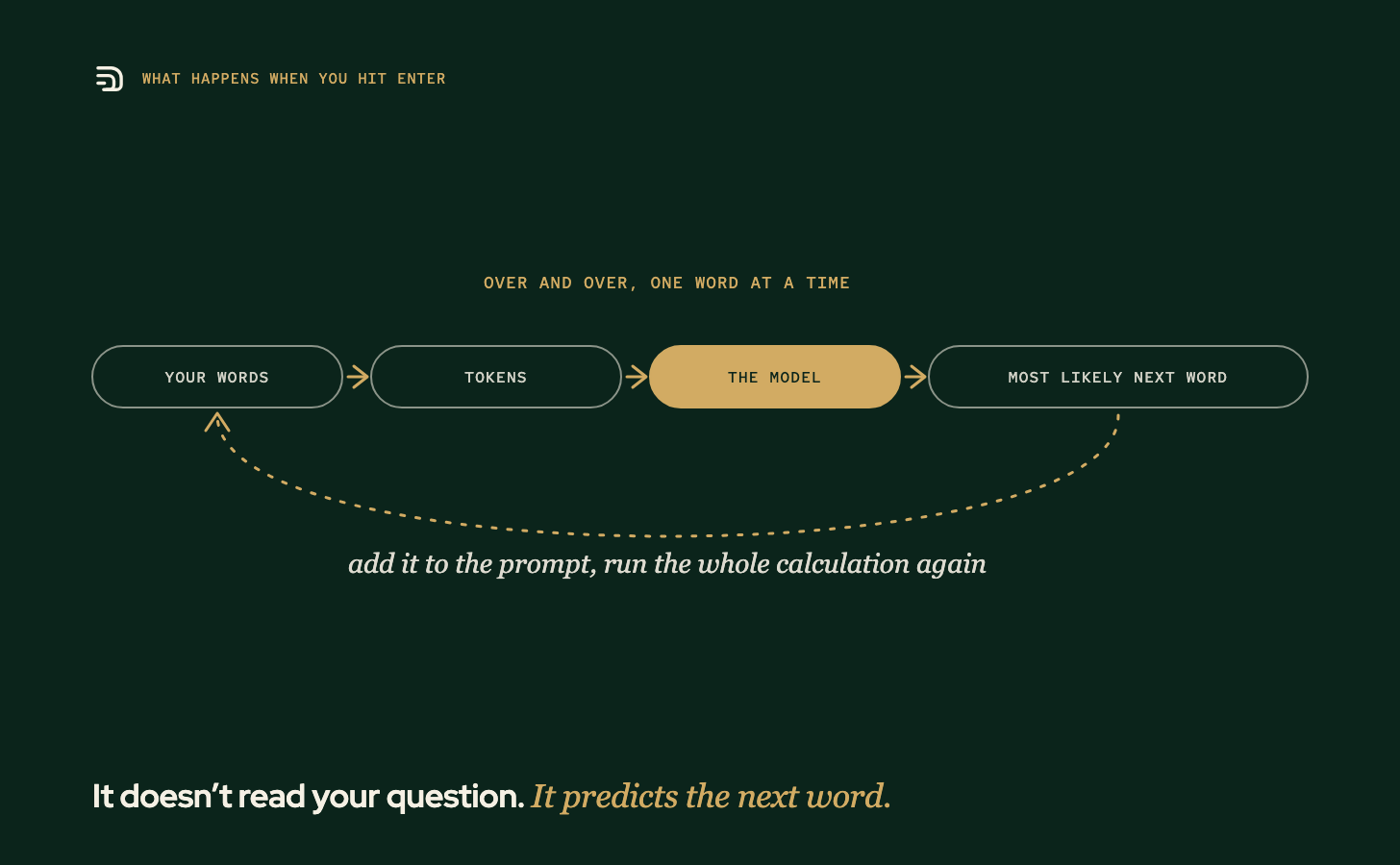
When you type a prompt and hit "Enter," that engine doesn't "read" your question and "think" about an answer. It doesn't comprehend your problem.
Instead, it converts your words into numbers (tokens) and runs them through the model to calculate the single most likely next word. Then, it takes that new word, adds it to your original prompt, and runs the entire massive calculation again just to guess the next word. Over and over, at lightning speed.
This is why engineers describe the math as probabilistic and stateless.
Probabilistic means the system isn't reasoning—it is just calculating the statistical probability of what word should come next, like an autocomplete on steroids.
Stateless means the underlying model has absolutely no memory. It resets to zero the moment it finishes generating an answer. It doesn't learn from your conversation. It just holds it in a temporary cache until you close the window, and then it is gone forever.
Because it is stateless by design, there is exactly one thing it fundamentally cannot do: it cannot carry compounding, in-the-moment context.
The Memory Wall
When people ask me about Artificial General Intelligence (AGI) — not the marketing version — I tell them the same thing: the bottleneck is hardware. And specifically, it's memory.
Processing power keeps getting cheaper. Graphics Processing Units (GPUs) are faster every quarter. But the ability to store, retrieve, and cross-reference information at the speed a human brain does? That hasn't caught up. Not even close.
Every piece of information an AI retrieves has to be fetched from physical storage — cache, Random Access Memory (RAM), Solid State Drives (SSDs), a data center somewhere in Virginia. Each layer adds latency. And as models grow, that latency compounds. The system computes faster than it can remember.
That is the memory wall. And it's fundamentally a physical constraint, not a software problem.
To understand the scale of this, look at the cost of memory. I remember upgrading my PC in 1994 just to play Doom. It required a minimum of 4MB of RAM. Back then, that 4MB stick cost around $150 — roughly $100,000 per gigabyte. Over the next thirty years, thanks to Moore's Law, memory prices dropped exponentially. By 2024, RAM cost barely $2 a gigabyte.
But starting in 2025, that trend violently reversed.
Driven by the AI boom, standard consumer RAM prices doubled in less than two years. Why? Because the companies that make it cannibalized their consumer lines to manufacture High Bandwidth Memory (HBM) for AI data centers. HBM is the only way to feed data to processors fast enough to avoid total gridlock. The demand is so intense that the latest HBM4 modules command a 50% premium over last year's tech, and availability is entirely sold out to hyperscalers.
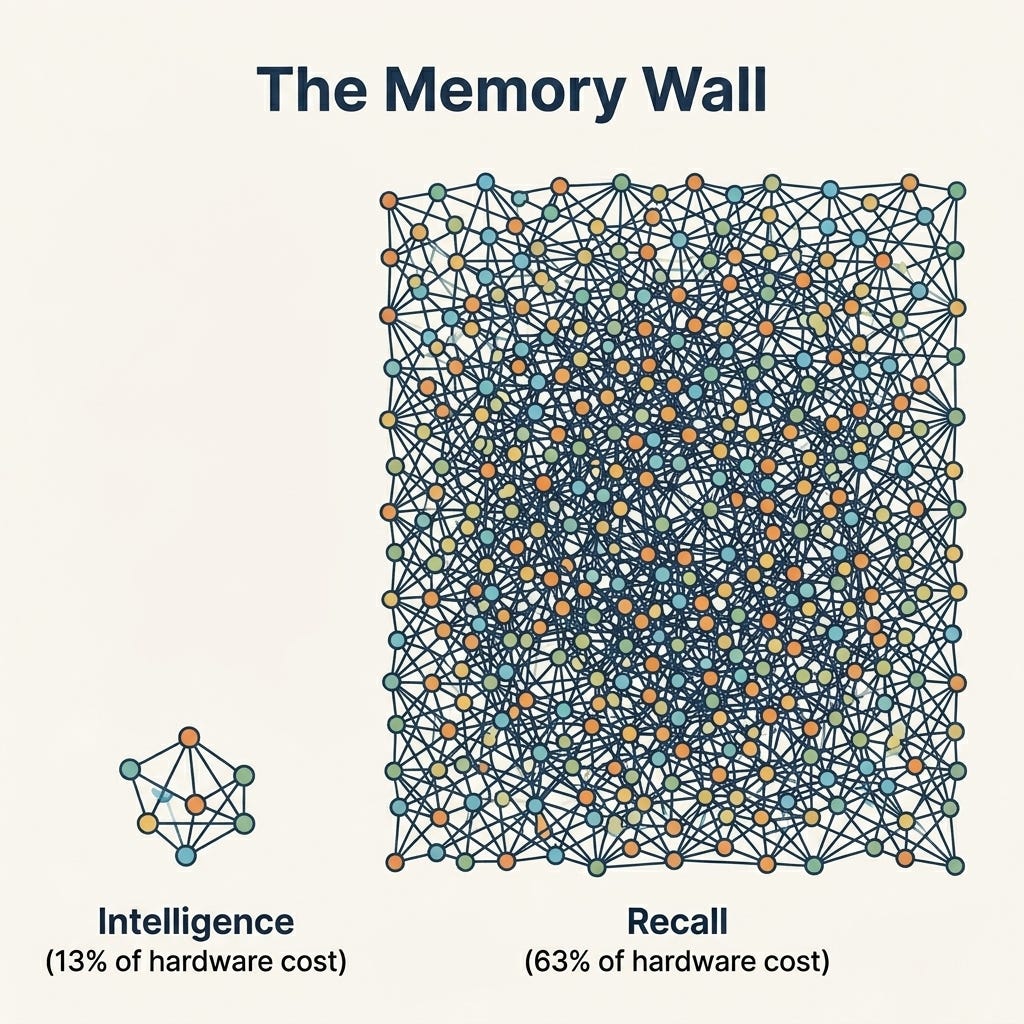
The cost structure of an AI chip has completely inverted. Today, when you buy a high-end AI accelerator, the actual "brain" — the logic die doing the computing — accounts for just 13% of the manufacturing cost. The HBM memory makes up 63%.
You are no longer paying for intelligence. You are paying for recall.
And that recall is staggeringly expensive. During inference, an AI must read its entire context memory — the Key-Value (KV) cache — from HBM for every single word it generates. For a modern large model, that consumes 1 to 3 megabytes of memory per token. If you feed it a long document, a single user's request easily eats 16 gigabytes of memory just to hold the context. Multiply that by thousands of users, and the system grinds to a halt not because it can't think fast enough, but because it can't move the memories fast enough.
Human cognition thrives on selective forgetting — it knows what to keep and what to discard. AI drowns in its own recall.
This isn't a problem we can just code our way out of, because memory scaling has hit a wall of fundamental physics.
Unlike logic transistors—which we just need to switch on and off really fast—a DRAM cell stores data as an electrical charge inside a microscopic capacitor. To pack more memory onto a chip, we have to shrink those cells. But at today's scale, the insulating walls inside those capacitors are literally only a few atoms thick. To compensate, manufacturers have started building them as incredibly tall, microscopic cylinders (aspect ratios exceeding 50:1) just to hold enough charge, and they are so thin they literally collapse during manufacturing.
But even if they don't collapse, they hit a harder limit: quantum mechanics.
When you build walls that are only a few atoms thick, electrons don't stay where you put them. They physically jump straight through the solid walls of the capacitor—a phenomenon called quantum tunneling. The memory literally leaks away. You can't just "engineer" your way around this because atoms have a fixed physical size. It is a hard limit of nature. We can shrink the "thinking" part of the chip, but the "remembering" part has collided with the periodic table.
The Desperate Counter-Narrative
If you talk to an AI researcher about this physical memory wall, they will likely tell you it doesn't matter. They will argue that we will simply bypass it.
Hardware researchers are desperately trying to find a way around the quantum limits of silicon by abandoning traditional charge-based memory entirely. Labs are experimenting with Phase Change Memory, using chalcogenide glass that physically shape-shifts at the atomic level between an amorphous and crystalline state to store data. They are developing Magnetic RAM, which stores memory using the magnetic spin of electrons rather than an electrical charge. Some are even exploring analog optical memory that runs on light (photons) instead of electricity.
But these are bleeding-edge experiments struggling with manufacturing yields, heat, and stability.
Meanwhile, software engineers are trying to bypass the hardware entirely with new algorithms. Right now, the industry is moving toward models like Mamba and State Space Models (SSMs). Instead of caching every single word in memory, these models compress the context into a fixed-size mathematical state. They essentially build a running summary that doesn't explode in memory size, theoretically allowing for "infinite" context windows. They also use quantization to shrink the data size from 16-bit to 4-bit, cramming more data through the same physical pipes.
It is a brilliant engineering workaround. It makes running the math much cheaper.
But whether you use shape-shifting glass, electron spin, or mathematical compression—it does not solve the fundamental difference between how machines compute and how humans reason.
Even if you give an AI an infinite context window with zero memory bottleneck, it still fails the "in-the-moment" test. Mamba and SSMs might aggressively compress data so the GPU doesn't run out of memory, but they still suffer from the same fundamental amnesia—starting at zero the moment you open a new session.
The Two Triangles
This permanent amnesia forces a completely different architecture of intelligence. Because the machine cannot remember, it must operate fundamentally differently than you do.
I explain it like this.
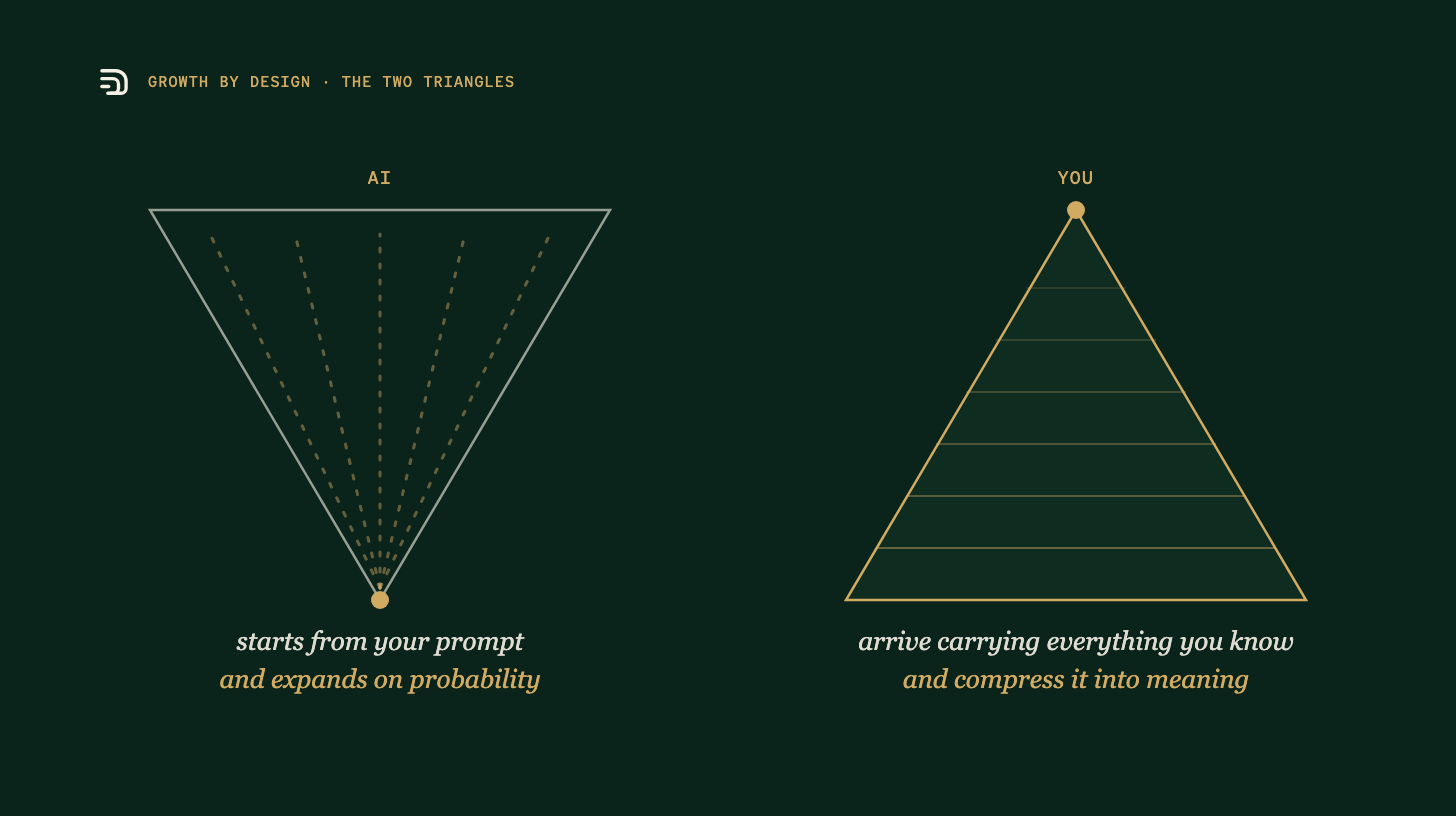
When you ask an AI a question, it starts from that single input and expands outward. It searches through its training data — billions of parameters — assigning probability to what comes next. Then the next thing. Then the next. Each layer fans out wider, connecting patterns across everything it has seen.
Picture an upside-down triangle. The point at the bottom is your prompt. The wide top is the expanding web of possible answers. Because AI has no base of memory to stand on, it can only build outward from the point of the request.
Now flip that triangle right-side up.
When a human faces the same question, they don't start from a point and search outward. They arrive at the question carrying the full weight of everything they've ever learned, felt, failed at, and remembered. All of that context — experience, intuition, mental models, emotional memory, cultural understanding — sits at the broad base. From there, the human compresses inward, narrowing all of that intelligence down to a single decision point.
AI expands from an input.
Humans compress from experience.
One operates on probability.
The other operates on meaning.
For what this looks like in a company, see what AI-native means for owner-led businesses.
Why This Matters More Than You Think
I was having dinner with a founder back in January, and I started riffing on this. He picked it up immediately.
"When a human thinks of information, they're building on a pyramid of knowledge," I said. "The sum of all intelligence. When AI answers a question, it starts from the point of the request and fans out to contextualize and bring it back — without any of those pre-existing assumptions."
He pushed back: "So you need a navigator. Someone who can translate across layers of AI."
Exactly.
Because the gap between what AI produces and what a business needs is context.
For an AI to have context, you must explicitly feed it the past. You have to inject the transcripts, the previous emails, and the CRM data into the prompt. It simulates context beautifully, but it requires the context to be codified and injected every single time.
Humans operate on implicit, in-the-moment context. We don't just recall the past; we actively synthesize it with the immediate, unstated present.
If a client pauses for half a second longer than usual before saying "yes," a human instantly cross-references that micro-hesitation against every interaction they've ever had with that client. They realize the deal is actually at risk, and they pivot the conversation. The human didn't need a prompt injected with the client's historical data. The context was active, implicit, and intuitively applied in the moment.
That's the pyramid of understanding. Humans sit at the top of it. AI has to rebuild it from scratch every time.
How To Do The 1 Thing It Can't
If you're a founder reading this, the takeaway is clear: stop waiting for AI to think for you, and stop fearing that it will replace you.
Instead, restructure your company to double down on the one thing the machine physically cannot do: compress compounding context into human judgment.
Start building systems that think with you.
Use AI for expansion, humans for compression.
AI is extraordinary at exploring scale. It can scan thousands of data points, test hypotheses, generate options. Let it fan out across the field of possibility.
But the decision — the compression of all that data into a single course of action — stays human. Because decisions carry weight, consequence, and context that AI can't hold.
Build your own memory system.
Since AI can't carry longitudinal context, your organization needs to. At GetFresh Ventures (GFV), we index every meeting, every decision, every milestone — and connect them across time and people. Each new conversation updates the full record. By the time we sit down again, the system already knows the story to date.
We call them Post-Meeting Context Reports. Each one references every prior report, building a living chain of reasoning. The company never forgets why a decision was made.
That's database economics applied to organizational intelligence. The same way a database creates indexes to make data retrievable, we create context indexes to make meaning retrievable.
Treat context as infrastructure.
Most companies generate more knowledge than they can retain. Slack threads disappear. Meeting context evaporates. Decisions get revisited without the history that shaped them.
When context is structured — tagged, linked, and retrievable — every future decision builds on every past one. That's how you compound intelligence instead of resetting it.
Measure learning velocity.
The companies that win in the next decade will be the ones that convert experience into shared understanding the fastest. AI accelerates the loop. But the human system design is what sustains it.
The Point
I've been saying this for a while now, and I'll keep saying it: AI handles the noise. Humans make the music.
The two triangles aren't competing. They're complementary. The upside-down triangle — AI expanding from inputs — and the right-side-up triangle — humans compressing from experience — create a complete architecture of intelligence when designed to work together.
But only if you understand the difference.
AI will keep getting faster. Models will get bigger. The demos will keep getting more impressive. And every few months, someone will declare that AGI is just around the corner.
It isn't. Not until we solve the memory wall. Not until machines can store and compress context the way we do.
Until then, AI will automate your tasks. But it will never do your job—unless you surrender the one thing it can't do.
Build your company around that truth.
What's one decision your company made this month that no AI could have made — because the context was too implicit, too personal, too in-the-moment to codify? I'd love to hear it in the comments.
If you want to see exactly how we build these compounding memory systems — and implement one yourself this week — grab the free Growth by Design™ CEO AI Kit.
Where would this pay off first in your company? The free AI Quick-Wins Report ranks your AI quick wins by payoff, with a first step for each.
This article is Part 1 of a multi-part series on the Applied Use of AI — exploring what is actually real, what is available right now, and how founders can build intelligent organizations that compound learning, context, and human judgment at scale.
Diraj Goel is the founder of GetFresh Ventures, where he builds Growth by Design systems for AI-native companies. He writes at Growth by Design.