
Growth by Design

Growth by Design

Fundraising for Your Crazy Wild Idea - A Growth by Design Cheatsheet

From Dream to Dollars: How to Fund Your Wild Idea When You’ve Got Nothing but Passion

Diraj Goel's avatar
Diraj Goel
Jun 26, 2025
∙ Paid

Hey there, visionary.

You’ve got a wild idea—a game-changing app, a disruptive AI tool, or something totally new—and you’re ready to bring it to life.

But with no traction, no working product, and no network, fundraising can feel like shouting into the void.

I’ve sat across from founders just like you, their eyes lit up with passion but their pitches weighed down by unproven assumptions. I’ve been there, too, grinding through the startup world, learning the hard way what it takes to get investors to care, let alone believe in you.

The good news?

You can raise funds, even when the odds seem stacked against you. Keep in mind, this is not for the faint of heart.

You still need to put in the time, unless you are a trust fund baby, then stop reading.

Also, to be clear, you should probably get a job to pay your bills while you navigating this journey until funding clears.

This Cheat Sheet, born from my heart-to-heart conversations with founders, will guide you to:

  1. Understand the investor landscape and who’s most likely to back your dream.

  2. Tackle the “pyramid of assumptions” that makes your pitch feel shaky.

  3. Navigate why fundraising is so tough and how to win despite the limits.

Let’s dive in and turn your crazy idea into a fundable reality.


Subscribe to the Growth by Design Founder Cheat Sheets now — new drop every Wednesday.

Part 1: Understanding the Investor Landscape

When I advise founders, I start by helping them see who’s out there to fund their dream. Not all investors are the same—each has different motivations, risk tolerances, and expectations, especially for early-stage ideas with no proof points. Here’s the lay of the land:
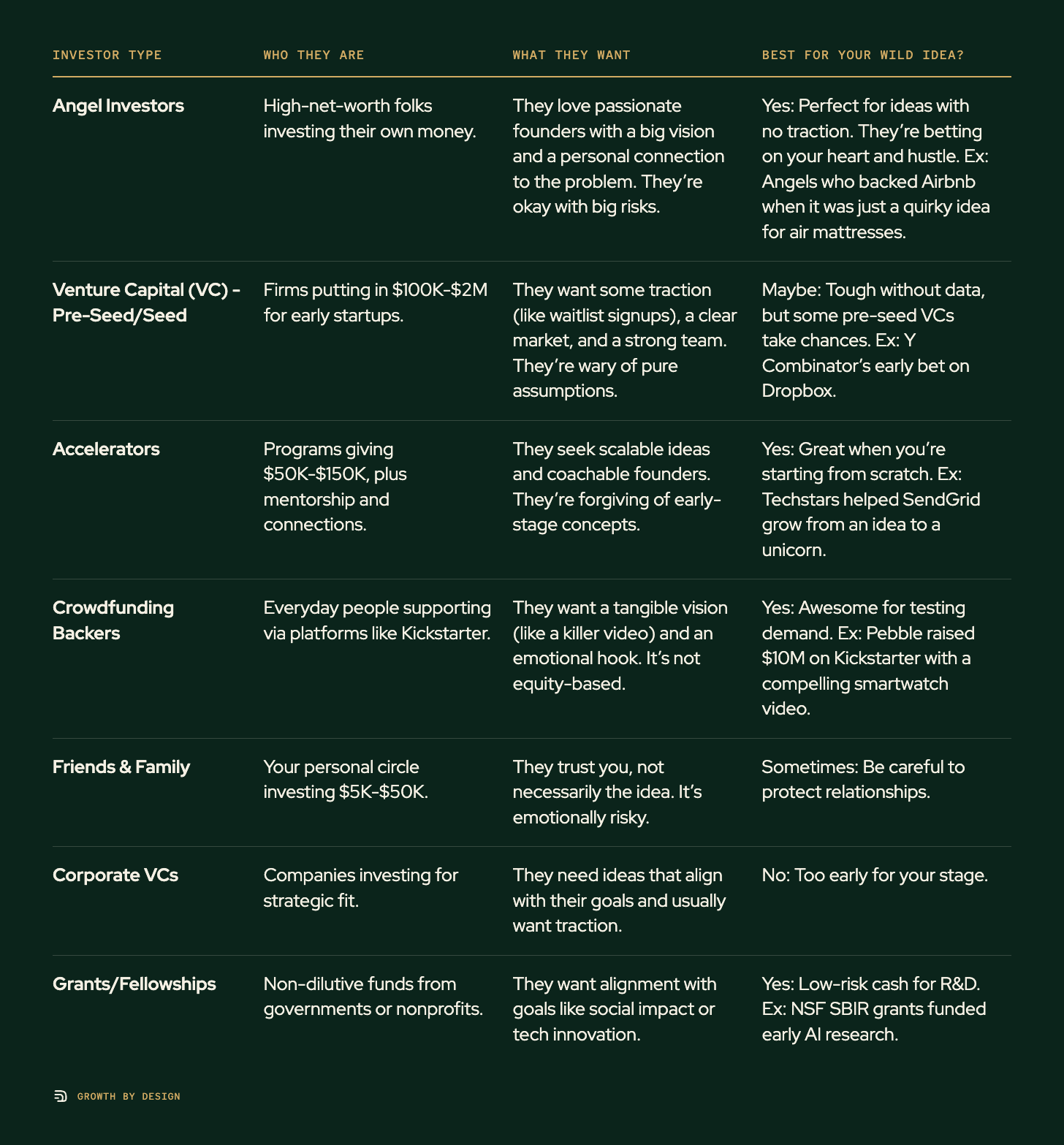
Table. Columns: Investor Type, Who They Are, What They Want, Best for Your Wild Idea?. Investor Type: Angel Investors; Who They Are: High-net-worth folks investing their own money.; What They Want: They love passionate founders with a big vision and a personal connection to the problem. They’re okay with big risks.; Best for Your Wild Idea?: Yes: Perfect for ideas with no traction. They’re betting on your heart and hustle. Ex: Angels who backed Airbnb when it was just a quirky idea for air mattresses.. Investor Type: Venture Capital (VC) - Pre-Seed/Seed; Who They Are: Firms putting in $100K-$2M for early startups.; What They Want: They want some traction (like waitlist signups), a clear market, and a strong team. They’re wary of pure assumptions.; Best for Your Wild Idea?: Maybe: Tough without data, but some pre-seed VCs take chances. Ex: Y Combinator’s early bet on Dropbox.. Investor Type: Accelerators; Who They Are: Programs giving $50K-$150K, plus mentorship and connections.; What They Want: They seek scalable ideas and coachable founders. They’re forgiving of early-stage concepts.; Best for Your Wild Idea?: Yes: Great when you’re starting from scratch. Ex: Techstars helped SendGrid grow from an idea to a unicorn.. Investor Type: Crowdfunding Backers; Who They Are: Everyday people supporting via platforms like Kickstarter.; What They Want: They want a tangible vision (like a killer video) and an emotional hook. It’s not equity-based.; Best for Your Wild Idea?: Yes: Awesome for testing demand. Ex: Pebble raised $10M on Kickstarter with a compelling smartwatch video.. Investor Type: Friends & Family; Who They Are: Your personal circle investing $5K-$50K.; What They Want: They trust you, not necessarily the idea. It’s emotionally risky.; Best for Your Wild Idea?: Sometimes: Be careful to protect relationships.. Investor Type: Corporate VCs; Who They Are: Companies inv

My Advice: When I guide founders, I point them toward angel investors and accelerators first. They’re the ones who’ll sit down, hear your passion, and take a chance on your vision, even if it’s just a spark. I’ve seen angels get excited about ideas that resonate with their own experiences—find those who feel your problem personally, like someone who’s felt the pain your idea solves.

User's avatar

Continue reading this post for free, courtesy of Diraj Goel.

Or purchase a paid subscription.
© 2026 Diraj Goel · Privacy ∙ Terms ∙ Collection notice
Start your SubstackGet the app
Substack is the home for great culture