


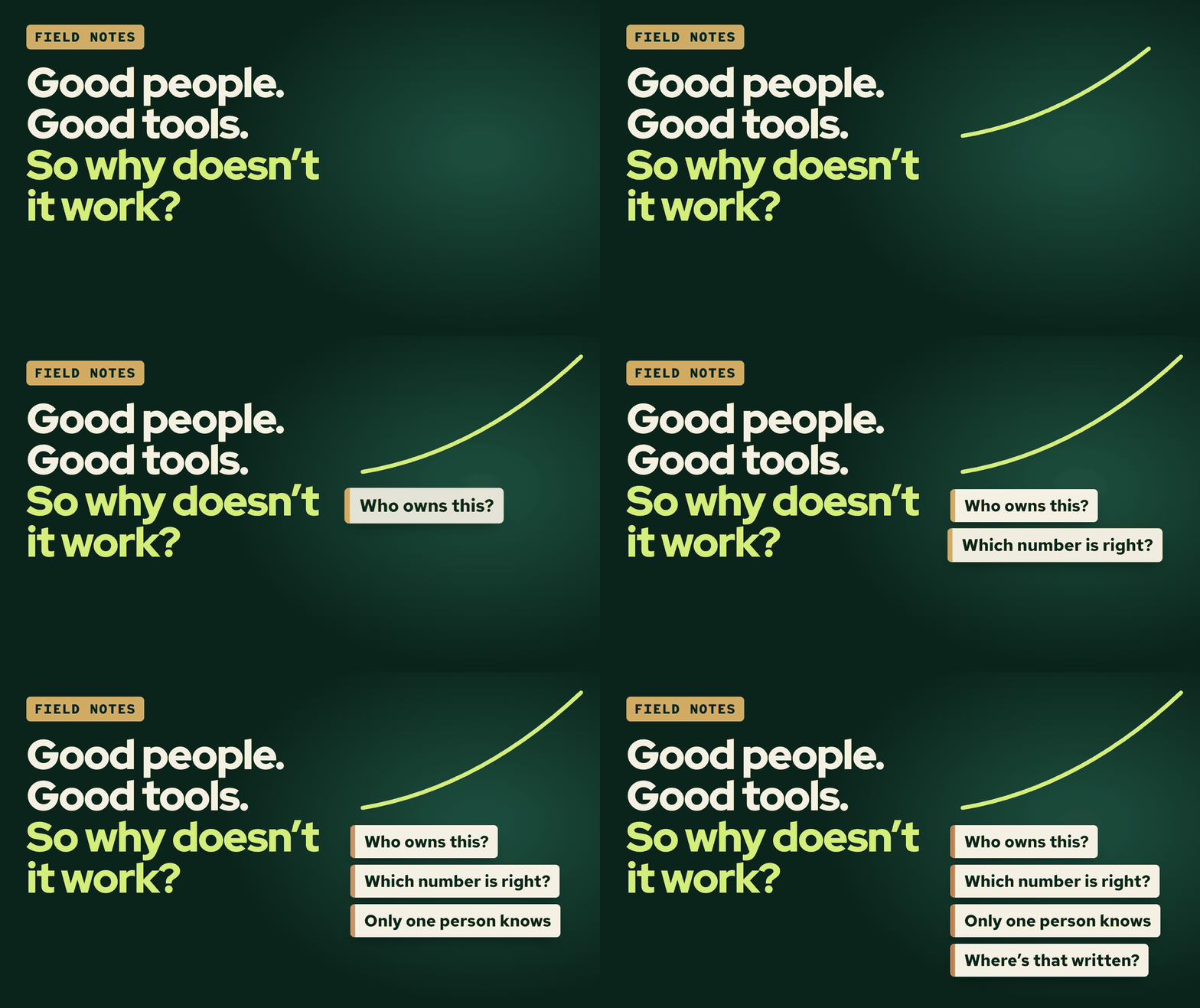
In January, PwC reported that 56% of the 4,454 CEOs it surveyed had seen no significant financial benefit from AI so far. A year earlier, IBM asked 2,000 CEOs about their investments, and half said the pace had left them with "disconnected, piecemeal technology."
I know that phrase. I wrote a version of it on a slide in 2009.
In 2008 I was watching CNN every morning, seeing long lines outside of banks, while my days were strained with too much work and too little time. We had a fledgling cybersecurity firm, right before the Vancouver 2010 Olympics, and more demand than we could keep up with. It felt unfair.
I'd been through a bust already. At WebCT, our Monday all hands meetings were in two rooms: one for the people being laid off, the other for those who still had jobs.
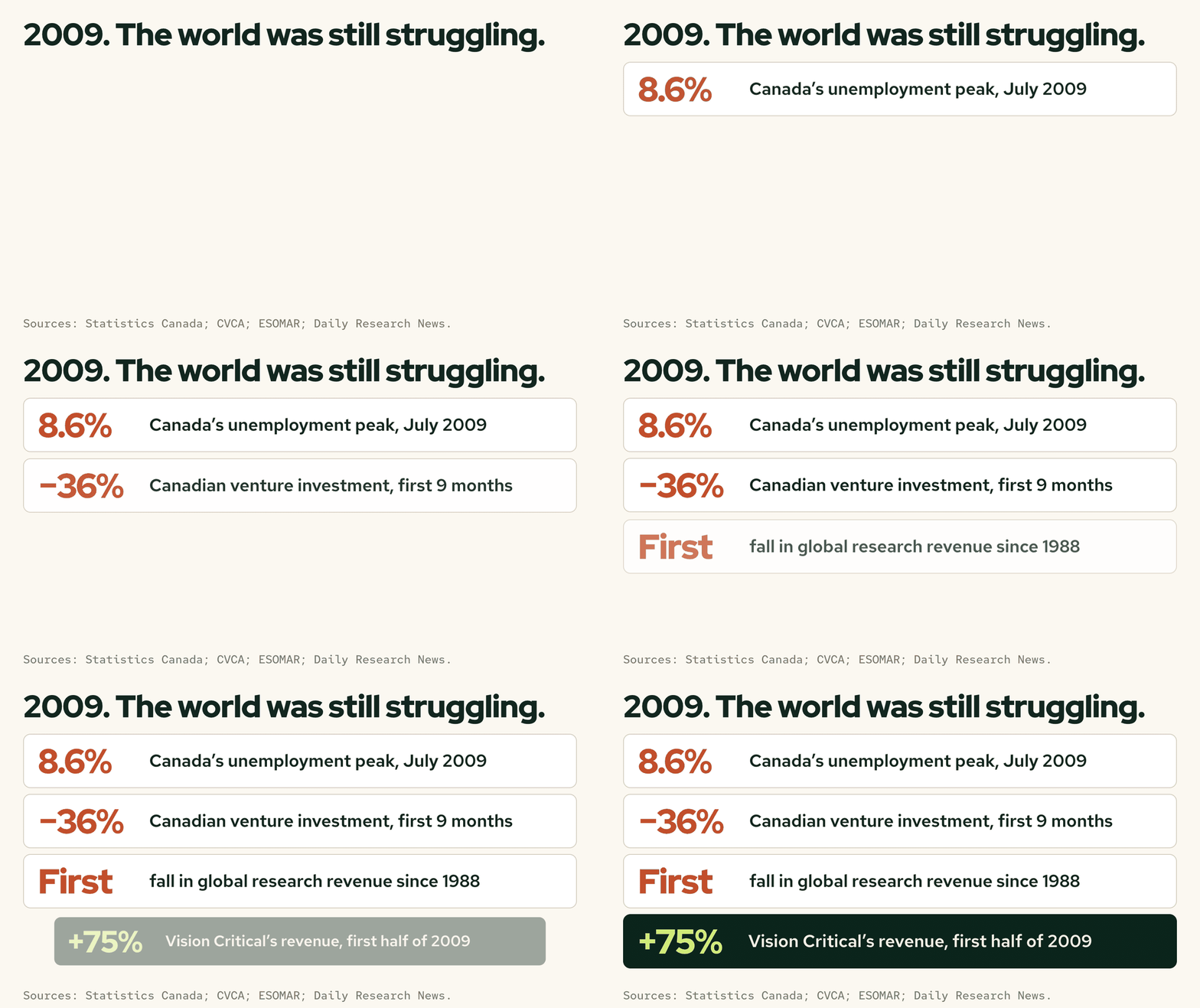
By the summer of 2009, the damage was everywhere. Unemployment in Canada peaked at 8.6% that July. Venture investment here fell 36% over the first nine months of the year. And global market research revenue fell that year for the first time since ESOMAR, its trade body, began measuring in 1988.
That August I was still consulting, and I had a decision to make. On August 12 I emailed someone I trusted: "Making an important decision soon and really need your advice." Two days later: "I took a job! The offer was too good to pass up."
The job was Director of IT at Vision Critical in Vancouver. A couple of friends from my WebCT days were already there.
It's called Alida now, so you may not know the name. Andrew Reid started it in 2000, after his father, the pollster Angus Reid, called him to rebuild his research firm's website. That same year Angus sold that firm to Ipsos. Andrew's company built virtual stores, so brands could test packaging and pricing before a launch. Then a project for Reebok, with a community of women runners, turned into something bigger: a private group of customers a brand could keep asking. By the time I arrived, Angus was CEO, and we were selling a new concept to market research firms that didn't use technology.
And in the middle of all that, we had more work than we had time to hire for. As companies struggled to keep up with customer sentiment and needs, they started to use communities and active market research to keep their customers close. Revenue in the first half of that year was up 75%, and the company hired more than 95 people that year. That October it merged with its sister firm, Angus Reid Strategies.
We were growing, but budgets were tight. Like really tight. If we had a bad couple of months, we froze hiring and the anxiety in the company went up for everyone. We couldn't raise a lot of money, so revenue paid for everything. We had to justify every project, every new hire, every dollar, so we got really good at buying things. We didn't have AI, so we had to use humans, which slowed things down. What we got the most value from was discipline. It meant more for our culture than foosball tables, free pop or beer Fridays.
And you couldn't just light up a piece of software then. We had to build the servers, networks and security ourselves just to get started.
If it was or needed to be plugged in, it was my team's domain: the systems our clients used and the systems our own people used, with about 25 people across IT and support.
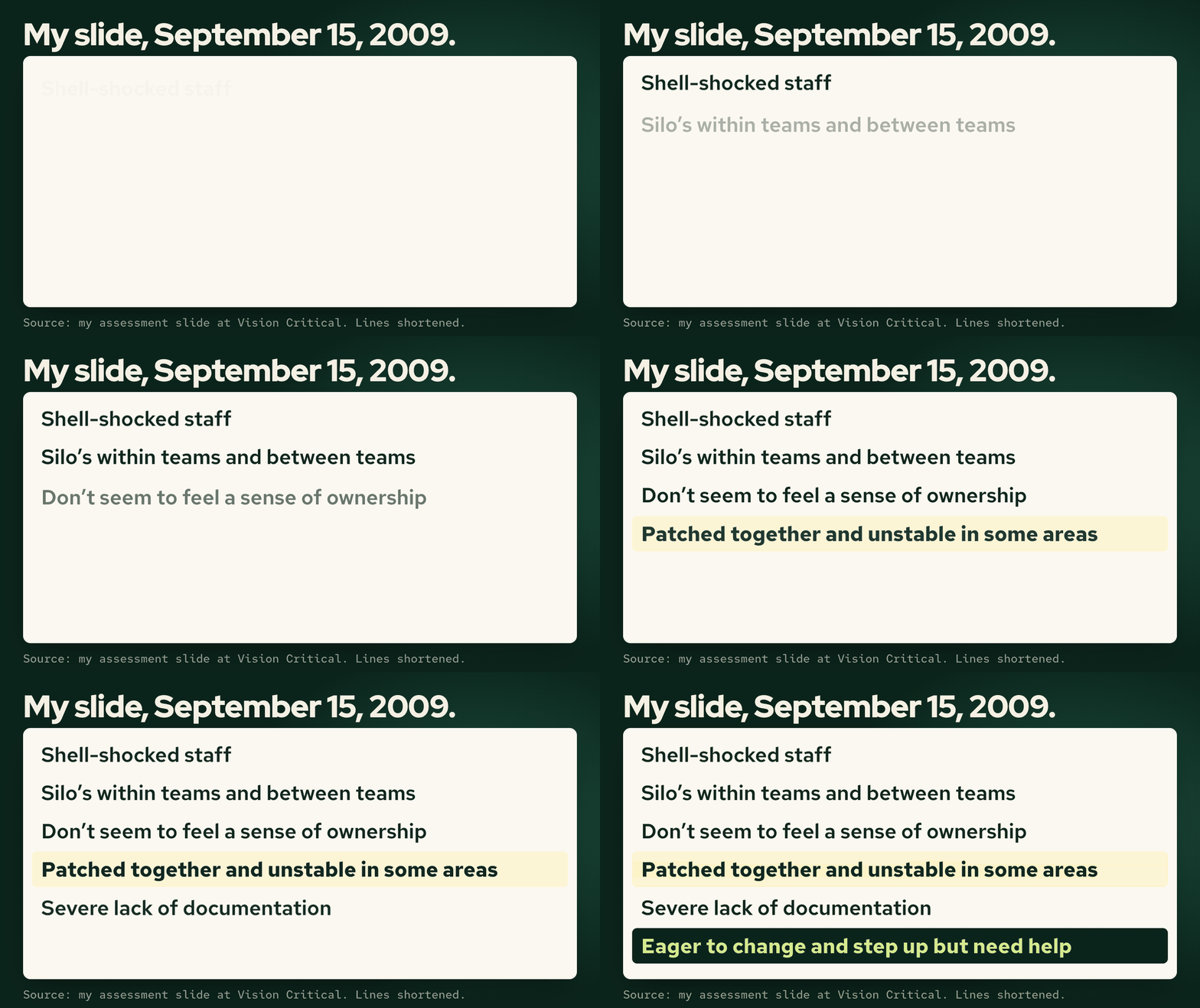
On September 15, in my first weeks, I made a slide of what I'd found.
"Shell-shocked staff." "Silo's within teams and between teams." "Don't seem to feel a sense of ownership." "Patched together and unstable in some areas." "Severe lack of documentation." And then the line I'd keep: "Eager to change and step up but need help."
The company was growing. The people wanted to do good work. My plan was short: "Gain trust and instill a sense of ownership and responsibility with tough love when necessary", set some KPIs, get small wins.
I left in January 2016, with the divestiture of our research consulting arm to MARU Group. A couple of months later, I called back, and one of the most junior people on the team told me: "It feels like... You haven't even left. Like, we miss you, but everything's operating, like clockwork." That was probably the best compliment I ever got.
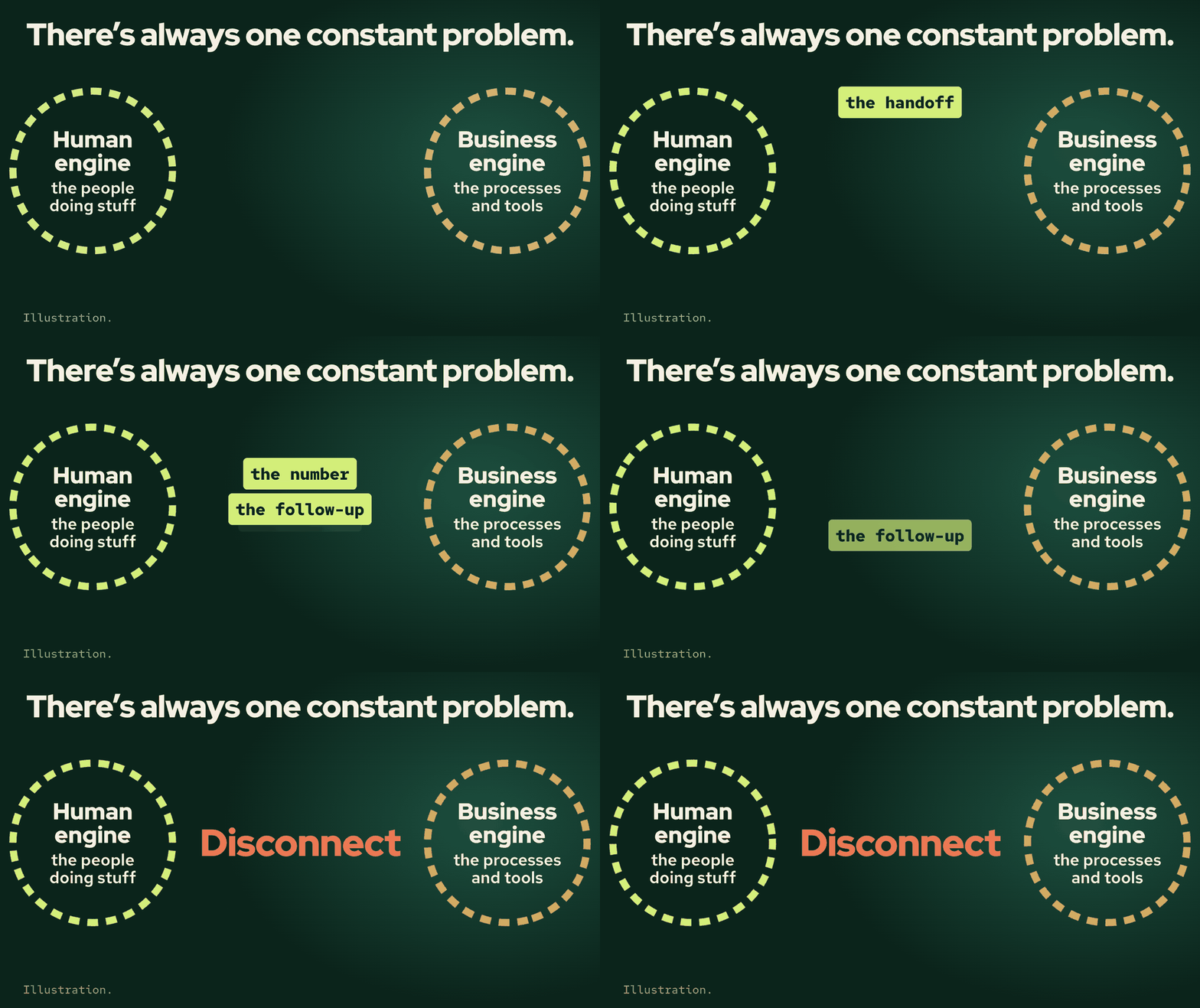
That job is where I started thinking of a company as two engines. In the years since, I've found there's always this one constant problem that creeps up: disconnect, in how the human engine, the people doing stuff, works with the business engine, the processes and tools, to get stuff done.
The next room
In 2016 I was at Hootsuite, a company seven years in and growing fast. The operations teams had to be integrated so we could understand the customer journey end to end, so we built a new team from the key players, with everyone rowing in the same direction.
I left that November.
The room that changed how I work
A few months later, Bill Tam at BC Tech asked me to redesign the HyperGrowth accelerator. I read the old curriculum. It used McDonald's as the branding example.
Nobody can use that. These founders didn't need an MBA class. They needed to know what to do now.
So we rebuilt it as 26 weeks and 13 teaching sessions. Each one was followed by a working session on their own business. Then they had to present it, and defend it with the numbers behind it.
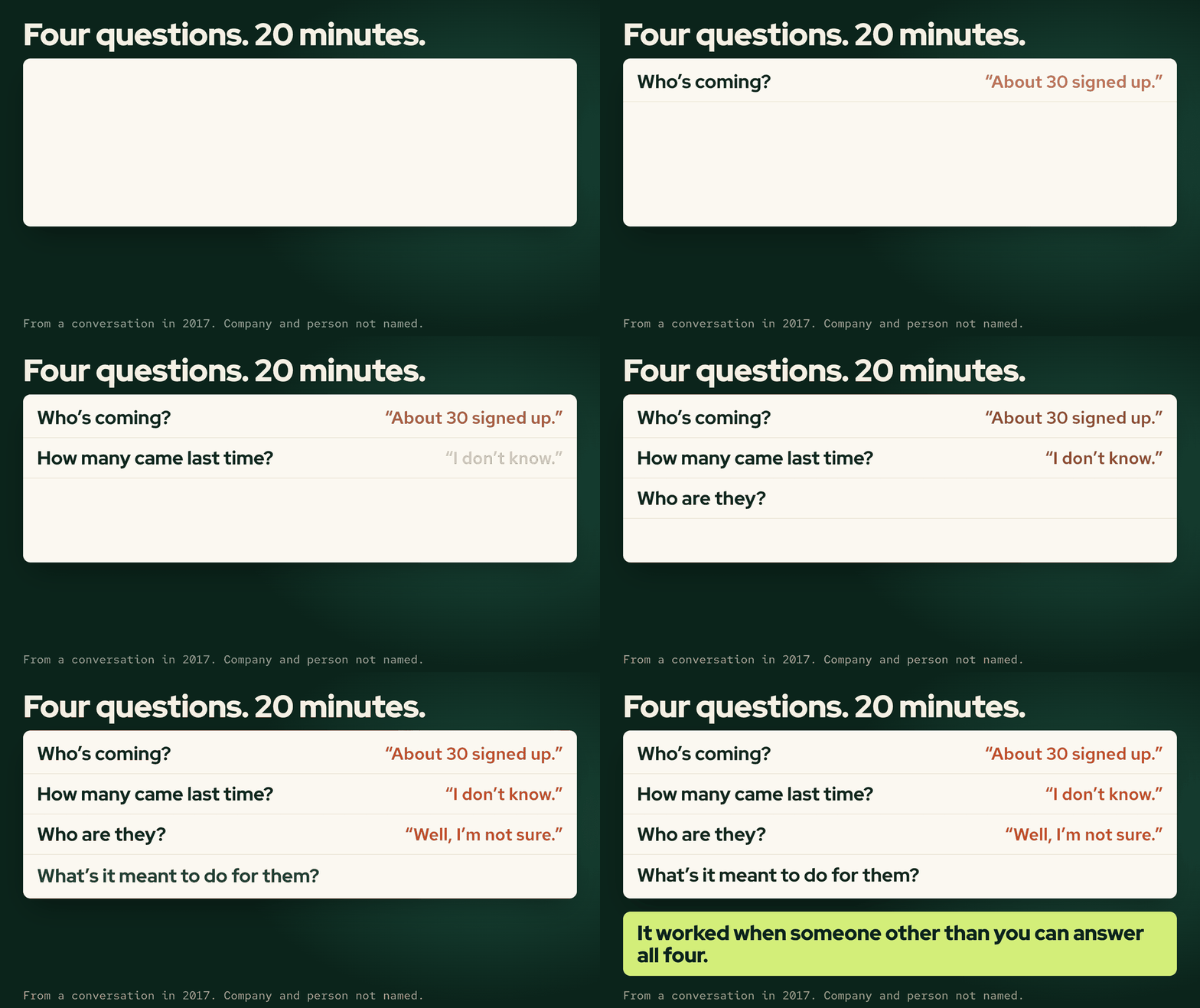
That same year, I stopped a head of marketing rushing off to a webinar and asked who was coming. About 30 people had signed up. How many would show? "I don't know." How many showed last time? "I don't know." Who are they? "Well, I'm not sure."
I told them to go to the webinar, come back, and we'd position it.
We called what we were building the growth engine. By 2018 I was calling it Growth by Design. I chose the name because it fit what we were doing: designing and engineering forward into a growth engine.
Why it's a practice now
For years Growth by Design was the method and this newsletter. Clients hired GetFresh Ventures.
I spent a full year heads down, building. By this October the engine was fully working, and it was time to focus on the market.
The problem was the name. GetFresh Ventures sounds like a venture fund, and people didn't know how to gauge us. On October 7, in our morning scrum, I said, "we have a branding issue." Our work was already called Growth by Design, and getgrowthbydesign.com was available. By the end of the month the site was live. This week we're launching Growth by Design as a practice within GetFresh Ventures.
An audit used to take me about two months and a whole bunch of people. Now we can do it in two weeks.
The same thing still comes up when we map a company today: "a lot of fundamental organizational issues that are kind of glued together by humans and intrinsic tribal knowledge." Where AI helps us most is in understanding the problem, and which problem to fix.
Being AI native means we start from the outcome and a work back plan to get there. The questions I asked in 2017 still come first.
Try this today
Pick your next campaign, event or big send. Take 20 minutes and ask whoever owns it:
Who's coming?
How many came last time?
Who are they?
What's it meant to do for them?
It worked when someone other than you can answer all four.
What's next
Each week I'll tell you something I lived, what I did about it, and what you can use. Paid subscribers get the templates and prompts behind each one. This week's: the check-in questions from that 2017 program, the teach-then-work format, how to pick three problems from a thousand, and a prompt that finds the disconnect in your own meeting notes.
One question: who on your team can answer those four questions today?
Reply and tell me. I read every answer.
Diraj
