


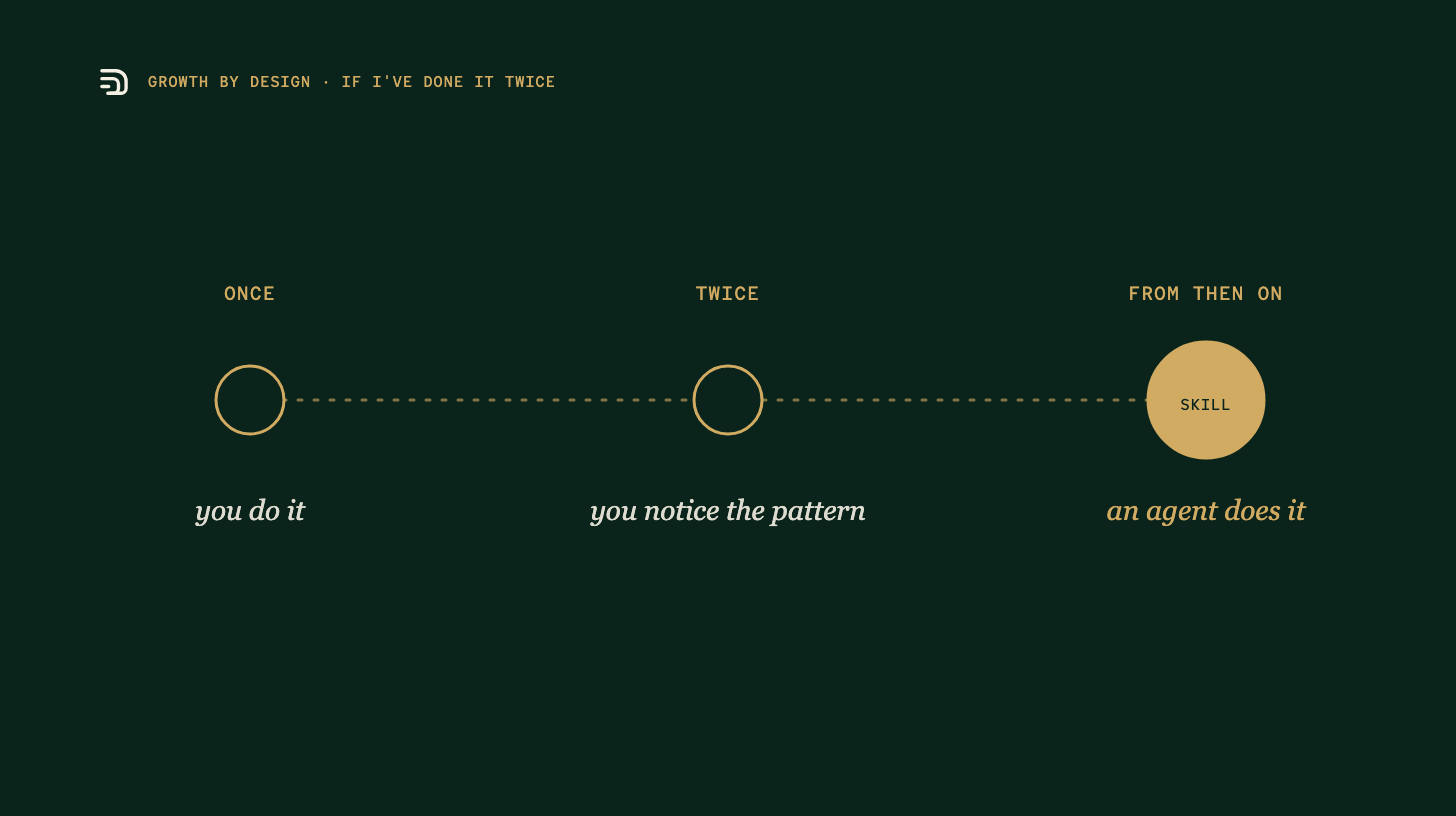
If you've done something twice, you shouldn't be doing it a third time.
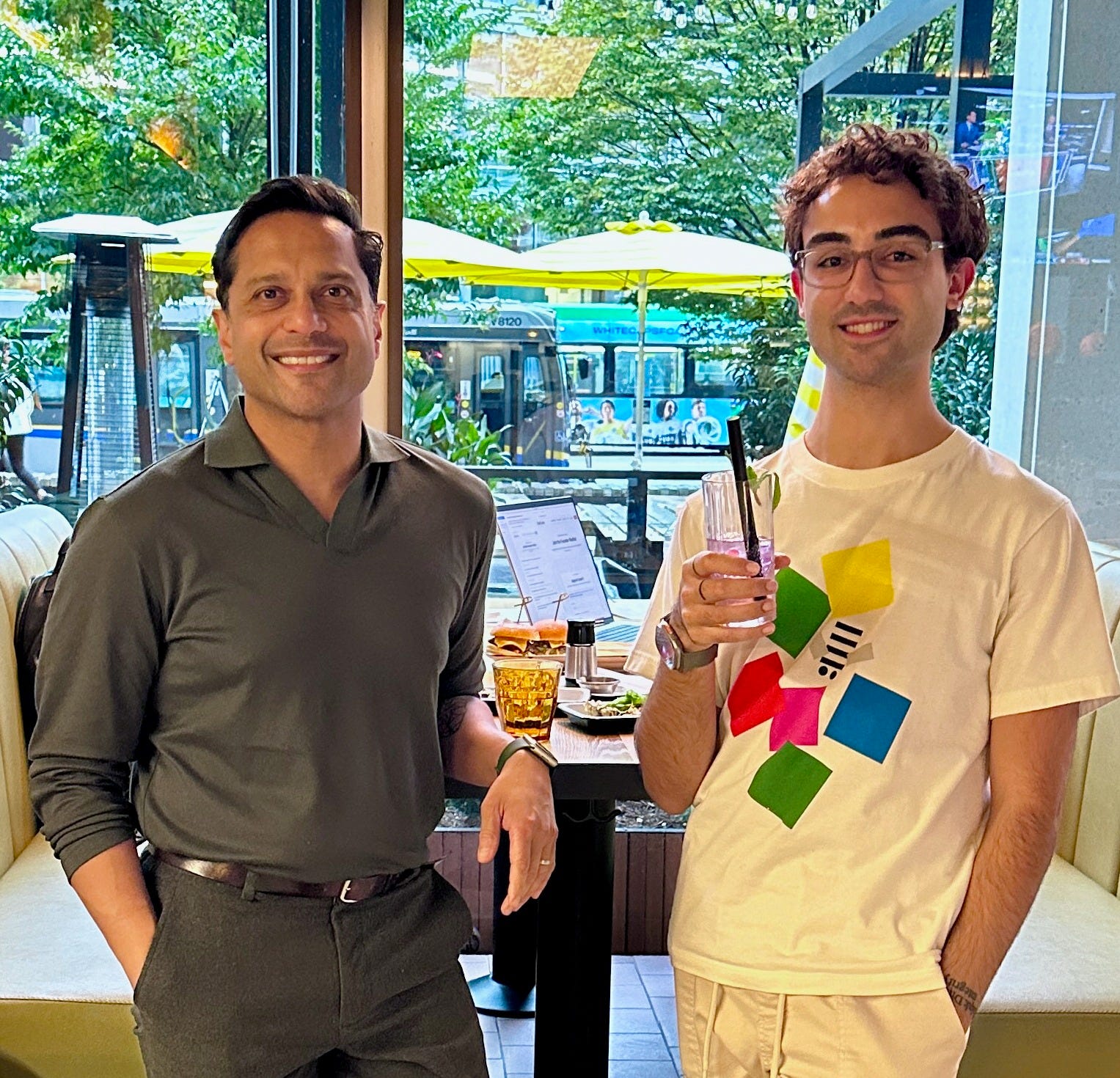
Diraj Goel (left), Founder & CEO of GetFresh Ventures, and Arvin Madhi (right), AI GTM Architect — Vancouver, BC.
Last July, as we were talking about working together, Arvin Madhi sent me a WhatsApp message: "I am ready to go for Monday ⚡️"
By Tuesday, he was mapping out how to orchestrate Zapier agents through Cursor — wearing an Apple Vision Pro while he did it. Within weeks, he had filed QA reports on our portfolio products, shipped fixes overnight, and started building what would become our Growth by Design AI GTM Lab.
He saw where our portfolio companies were losing time — manual follow-ups running on human memory, context scattered across platforms, an ocean of insight trapped in meetings, Drive folders, HubSpot timelines, and WhatsApp threads. He started engineering the infrastructure to capture it.
Arvin is our AI GTM Engineer. The role is new. The need for it is not.
Before we dive in: we've open-sourced the foundation Arvin built. You can fork our internal agentic architecture — the GFV CEO AI Kit (link below) — and start deploying it to your own business today.
Revenue Systems Are Engineering Problems
Every growth-stage company reaches the same inflection point. The strategies that carried you to $3M start producing diminishing returns at $8M.
The playbooks get stale. The agencies recycle the same media mix. The fractional exec brings pattern recognition from their last three engagements — patterns that may have expired.
The underlying issue is architectural. Revenue generation is a systems engineering problem. Pipelines, conversion paths, attribution loops, campaign orchestration, lead scoring — these are interconnected subsystems with feedback mechanisms.
Treating them as marketing tasks assigned to humans creates latency. Every handoff is a delay. Every weekly sync is a batch process in a world that demands real-time.
What an Agentic System Actually Does
One of our portfolio companies — a multi-market home services operation — had a dashboard that fired 350+ API calls every time someone loaded the page. Thirty-six megabytes per refresh. Every click compounded it. A Vercel alert hit at 5 GB of data transfer in thirty minutes.
The fix took one session. Moved everything to a server-side cron that pre-fetches data every fifteen minutes. The dashboard now loads in under a second. The team gets the same data. The system handles the mechanical work.
That is the difference between a tool and a system. Tools require humans to operate them. Systems operate continuously and surface results.
At GetFresh Ventures, our Proactive Intelligence Layer monitors 491,000+ data points across 19 sources — Gmail, HubSpot, Google Ads, GA4, Fathom transcripts, WhatsApp threads, Slack conversations, QuickBooks invoices. Every signal feeds a unified ontology of 81,000 entities and 103,000 facts.
A deal that went cold gets flagged with the specific conversation where momentum stalled. A campaign generating clicks but zero booked jobs gets throttled before the weekly review. A competitor's pricing change detected through web monitoring triggers an automatic brief for the sales team.
This is the work that used to require a fractional CMO, a RevOps analyst, a data engineer, and a weekly all-hands. The system runs continuously. Humans focus on judgment — strategy, relationship building, the moments that require empathy.
Continue reading to grab our Growth by Design CEO Kit.
The Philosophy: If I've Done It Twice, It's Getting Automated
Arvin said something early on that captured the mindset:
"If I've done it twice, it's getting automated. And if I've built it once, I'm finding the next version that scales itself."
This is the operating principle of a GTM AI Engineer. The role exists at the intersection of three disciplines that traditional hiring treats as separate: growth strategy (what to build), systems engineering (how to architect it), and AI integration (how to make it self-improving).
A fractional CMO brings strategy and experience. A RevOps manager brings process and tooling. A data engineer builds pipelines. The GTM AI Engineer builds the system that absorbs all three — and gets smarter over time.
The role is rare because the instinct is rare. Most operators see chaos and add people. The GTM AI Engineer sees chaos and builds infrastructure to route around it.
The Compression Thesis
Software costs are compressing toward zero. The marginal cost of building a CRM dashboard, a reporting layer, or a campaign optimization loop approaches nothing when AI writes the code.
The moat shifts. Companies that win own the outcome architecture — the specific arrangement of data flows, decision rules, and feedback loops that produce revenue. The code is commodity. The system design is the asset.
Consider what our team built for a multi-market home services company. The ServiceTitan API returns invoice data, but the native payload for warranty recalls and membership checks has null items — nothing billed. The materials the operations team sees live on the estimate, not the invoice. A human analyst would spend hours reconciling this weekly. Our engineer added a new connector endpoint — `get_estimate_items` — so the dashboard pulls from the correct source automatically. One build, permanent fix.
That is the difference between an agency retainer and a systems investment. The agency would have built you a report. The system built itself a better data source.
The Translator Layer
Most companies attempting AI adoption fail at the same point. They buy tools. They integrate APIs. They build dashboards. The technology works. The organization does not change.
The gap is translation. Between what the CEO wants ("grow revenue 40%") and what the system needs ("define the conversion events, map the attribution windows, establish the feedback loops, set the optimization constraints").
The GTM AI Engineer is the translator. Intent becomes specification. Specification becomes automated workflow. Automated workflow becomes self-improving system.
For one portfolio company, we identified that their Utah market had a combined capture, conversion, and attribution system problem — the answer was not "run more ads." The answer was engineering an offline conversion pipeline that reconciled call tracking data with job completions in ServiceTitan, then fed that back into Google Ads for automated bid optimization. The system replaced six hours of weekly manual reconciliation with continuous, autonomous operation.
The 90-Day Build Pattern
At GFV, we deploy agentic systems in 90-day sprints. The cadence is deliberate.
This is the same rule we use in client sprints.
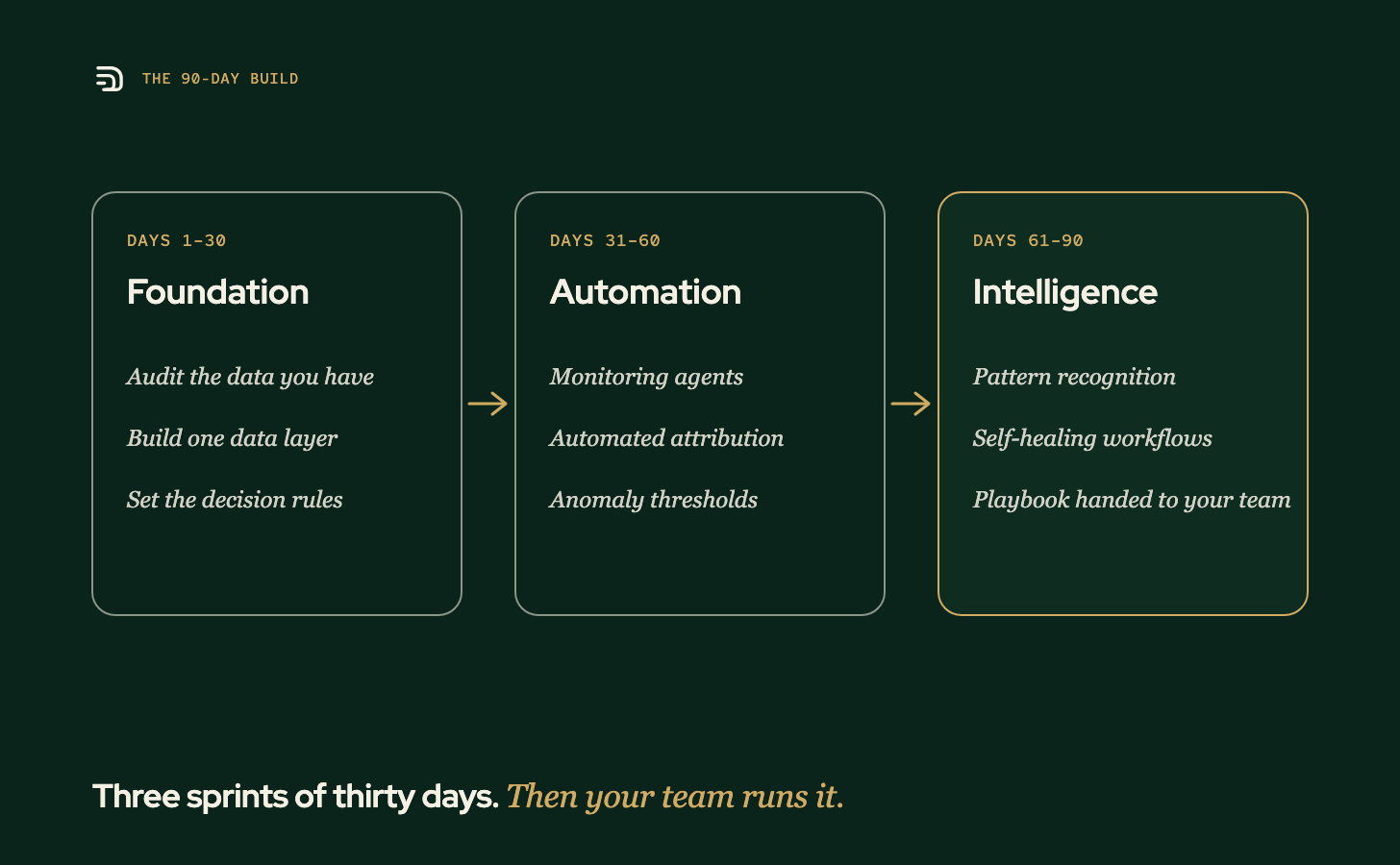
Days 1-30: Foundation
Audit existing data architecture (CRM, analytics, ad platforms, billing)
Build the unified data layer
Establish baseline metrics with automated collection
Define the decision rules the system will enforce
Days 31-60: Automation
Deploy continuous monitoring agents
Build self-adjusting campaign management
Create automated attribution pipelines
Establish anomaly detection thresholds
Days 61-90: Intelligence
Train pattern recognition on company-specific data
Build predictive models for pipeline velocity
Deploy self-healing workflows (system detects and fixes its own failures)
Hand off operational playbook to the internal team
The output is a revenue system that operates with minimal human intervention. The company retains a relationship for strategic oversight — course corrections, market pivots, new channel evaluation. The mechanical work is handled by the system.
Within our portfolio, we've seen this pattern produce Semrush SEO integration built and deployed in an afternoon. Campaign bid adjustments running hourly instead of weekly. Dashboards that went from 350 API calls per load to pre-cached, instant renders. ServiceTitan connectors with full pagination, auth, and error handling — shipped overnight.
What This Means for You
The question is directional.
Companies investing in agentic infrastructure today are building compounding advantages. Each day of automated data collection, pattern recognition, and system optimization creates intelligence that manual processes can never match.
The companies still running weekly pipeline reviews, manually updating CRM fields, and waiting for monthly agency reports are accumulating technical debt in their revenue operations.
Every manual process is a liability. Every automated feedback loop is an asset.
Where in your revenue system do humans perform mechanical work that a system could handle continuously?
What decisions are you making on stale data because the pipeline to fresh data requires manual effort?
If your fractional exec left tomorrow, how much of their value was institutional knowledge versus repeatable process?
What would change if your campaign optimization ran every hour instead of every week?
How much revenue intelligence are you losing between the cracks of your disconnected tools?
Build the System
We don't scale chaos. We design engines that scale clarity.
The GTM AI Engineer is a new role. The companies adopting it are building infrastructure that compounds. Revenue is an engineering outcome.
If you want to see how this works in practice, we've open-sourced the foundation. You can fork our internal agentic architecture — the GFV CEO AI Kit — and start building your own self-healing revenue systems today.
Build accordingly.
If you are building at the intersection of AI and revenue operations, I want to hear what you are seeing. Find me on LinkedIn or reply to this.
Learn more about the Growth by Design methodology.
Where would this pay off first in your company? The free AI Quick-Wins Report ranks your AI quick wins by payoff, with a first step for each.