



A common challenge on my coaching calls:
A founder walks in with a software product. Revenue is growing. Features are shipping. AI is wired into the stack. And the question they keep asking is the same one: "Why are my customers still so dependent on me no matter what I do to enable them?"
Because the software is not the product. The work is the product. Their transformation is the product.
AI is compressing the cost of building software toward zero. And that compression is doing something most on the venture stage are avoiding to say out loud.
It is moving us back to services.
The Sequoia Thesis
Sequoia just published a piece called Services: The New Software. Julien Bek lays out a clean argument: for every dollar spent on software, six are spent on services. AI autopilots will capture that services budget by selling outcomes instead of tools. The next trillion-dollar company will be software masquerading as services.
It is a sharp piece. The intelligence-to-judgement spectrum is useful. The copilot-to-autopilot convergence is real. The outsourcing wedge is well-mapped.
And the direction is backwards.
Every SaaS Started as a Service
Here is the part of the story that gets lost in the pitch deck.
Salesforce replaced the admin who maintained the Rolodex. QuickBooks replaced the bookkeeper who ran the ledger. HubSpot replaced the marketing coordinator who sent the newsletters. Zendesk replaced the call center agent who picked up the phone.
The entire SaaS movement was a migration from services to software. From Full-Serve to Self-Serve.
The reason it worked was not because the software was smarter. It was because the cost of building and distributing software dropped low enough that productizing the service became economically viable. Cloud infrastructure. Open-source frameworks. App stores. API ecosystems. Each wave made it cheaper to encode a service into code and sell it at scale.
That was the last twenty years.
Now the cost of building software is collapsing to near zero.
The Compression Thesis
When it cost $500K and 18 months to build a software product, you had to choose. Are we a services company or a software company? The economics forced the decision. You could not afford to be both.
When it costs $5K and 18 days, that constraint disappears.
And when the constraint disappears, the question flips. It is no longer "how do we productize our service into software?" It is "why would we sell software when we can just do the work?"
AI is not just making software better. It is making the creation of software so cheap that the economic moat around SaaS — the high cost of building and maintaining a product — evaporates.
If anyone can build the tool, the tool is not the moat.
The work is the moat. The outcome is the moat. The relationship is the moat.
Full-Serve, Assisted-Serve, Self-Serve
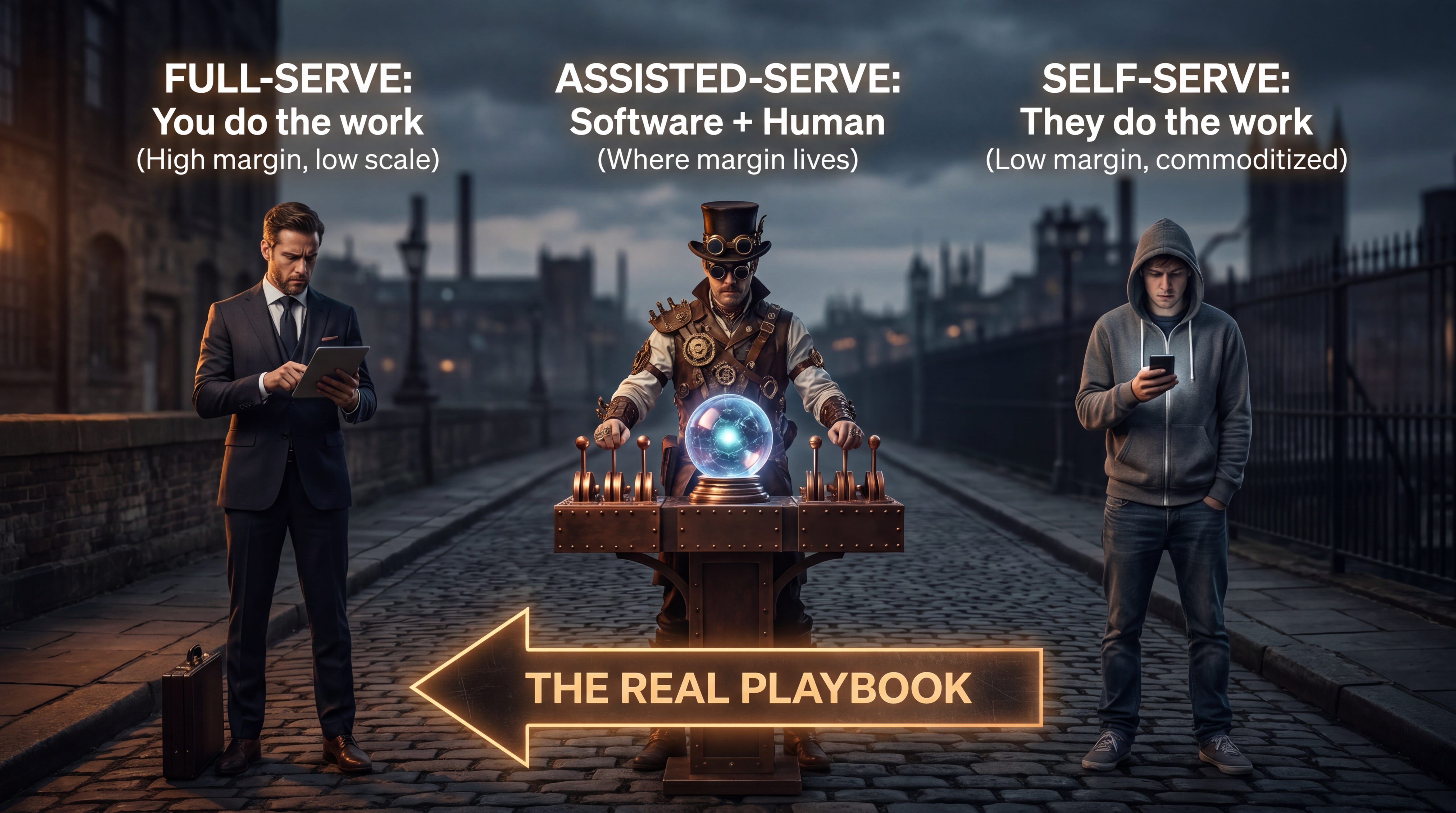
I use a model with every founder I coach. Three modes of delivery.
